
Podcast Episode
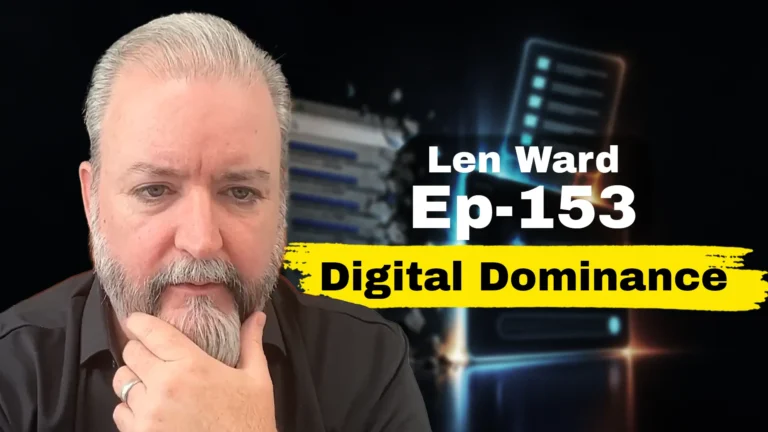
Search & Retrieve Is Dead: Len Ward on Building AI That Actually Solves the Problem
Len Ward
Episode Notes
Summary
In this episode, Len Ward discusses how AI is transforming business operations from search and retrieve to problem-solving, emphasizing the importance of systems and company-wide integration. He shares insights from his career journey and offers practical advice for leveraging AI to stay competitive.
Takeaways
- The shift from search and retrieve to problem-solving with AI
- How to build a company-wide AI system or ‘company brain’
- Practical steps for organizing data for AI integration
- The role of AI chatbots in customer engagement
- The importance of human oversight in AI deployment
- Emerging roles like AI pilot and data room manager
- The speed of AI adoption and future implications
Chapters
00:00 Introduction to AI’s Shift from Search to Problem Solving
02:03 Len Ward’s Career Journey and Recognizing Change
04:02 The Impact of ChatGPT and AI on Business
06:02 The Seismic Shift in Business Models
08:03 How AI Changes Customer Interaction and Funnels
09:59 Optimizing for AI and the Ecosystem of Platforms
11:51 Moving from Random Acts of AI to Systematic Integration
13:58 Building a Company Brain and Data Organization
16:03 Human Oversight and New Roles in AI Era
17:53 Preparing for the Future of AI in Business
20:09 AI as Jarvis: The Future of Business Assistants
21:50 Implementing AI Chatbots for Customer and Internal Use
23:48 Organizing Data and Starting Small with AI
26:01 Addressing Fears and Embracing AI Opportunities
27:48 Final Advice and Next Steps for Business Leaders
Free High-Converting Website Checklist: FroBro.com/Checklist
Transcript
Jeffro (00:01.418)
What if the problem isn’t that you’re behind on AI? It’s that you’re using AI like a search bar when your customers already expect you to solve the problem. That’s the shift that Len Ward keeps hammering from search and retrieve to solve my problem. He founded Comexis after a path that sounds unlikely until you hear it, Wall Street at Morgan Stanley and Credit Suisse, then e commerce, then digital marketing, and now installing the AI systems businesses actually run on. It’s the same job every time, turn messy information into decisions people can act on so in the next twenty five minutes or so, Len’s gonna unpack why random acts of AI actually stall growth, what a company brain actually means, and how a local service business can move from dabbling with tools to systems that qualify leads, compress sales cycles, and cut operational friction without waiting for the perfect tech stack. So Len, welcome to digital dominance.
Len Ward (00:52.302)
Thanks for having me. Appreciate it.
Jeffro (00:54.567)
Absolutely. Now, I mean you went from Morgan Stanley and Credit Suisse into e commerce, digital marketing, now AI implementation. What’s the through line? You know, what problem have you been solving in every chapter?
Len Ward (01:05.538)
I think I think it’s noticing the the coming changes. So, you know, when I was back on, you know, back on Wall Street, that was during the dot com era when everybody was talking about the rise of the internet, you know, the rise of the technology sector, cell phones and so forth. So you were really seeing that and you noticed like a lot of companies were slow to the punch on that. then when I got to e commerce, it was the same thing. Like we were, you know, we were beating other companies to the punch because we realized people were purchasing things online.
We owned an event, event concert and sporting event ticket shop. And we’re noticing people were making purchases online opposed to showing up at a store to buy it. then when it came to digital marketing, you know, I think one of the things that we really kind of, you know, were hammering home was obviously the need for search engine optimization, but we also recognized our agency, the the power of social media when that was rising. When people, you know, 15 years ago, you couldn’t get anybody on social media. They were scared to death of it. and then video.
Believe it or not, video term video was a short lived blip, but I I think it, in my opinion, is probably the most profound impact on digital marketing that we’ve had. And a lot of people don’t really talk about that too much. but video, so we kind of got people in Corpio and video. And I think AI, you know, is kind of going to be the anchor where I’ll probably my career will kind of segue out from where I’m at, where I noticed that it was every single thing we’ve built over the last 20 some odd years from digital marketing and the .com era.
All the way to now, everything’s is completely changed, even more so than I saw even with the .com era and so forth. This is a vastly, vastly different beast. So I think if there’s a common theme, it’s that constant being able to identify, hey, we have a change right ahead. I’m not saying it’s right or wrong. I just always had that ability to say, hey, look, I think something’s coming. And and and sure as heck, it showed up.
Jeffro (02:53.157)
And so you’re spotting the shifts, but you’re actually acting on that information. I think a lot of people just pat them on the cell their selves on the back like, yeah, I knew that was gonna be big and they’re like, Yeah, but you didn’t do anything about it. when did you first realize that AI wasn’t just kind of another channel atom, but actually a change in how business operates?
Len Ward (03:03.746)
Thing you
Len Ward (03:12.822)
We tested out IBM Watson years ago. We bought a subscription. I forget how it was, but I think it was subscription. And we tested it out and we gave it a chance and it didn’t work at all. But we knew we we kind of got the idea of what it was trying to do and we were saying to ourselves, okay, this is gonna be something different. Then there’s a few tools that came out that were definitely AI tools helping you write things you know, because you know, writing in the industry has always been long been one of the biggest bottlenecks of our industry and it was really helping. And it wasn’t an old school scraping, taking old content and spinning it. It wasn’t doing that. It was creating brand new content, which was really good. But then obviously when ChatGPT was released, I mean, I always said if you had a background on search engine optimization and you truly understood stood that, you had a very unique knack.
For having understanding how people’s dialogue is, especially online. So SEO people have really, really been very quick to adapt, I think, to AI. So we would take our SEO minds and start running through through some of the queries and, you know, the prompts, they will call it on Chat GPT. And we looked around and we were like, this is, I mean, everything is gonna change forever and and it has.
Jeffro (04:23.579)
So I you’ve framed this shift as moving from search and retrieve to solve my problem. Can you explain what you mean by that in plain English for someone who still might think of Google as the front door to the internet?
Len Ward (04:36.258)
Yeah, so ChatGPT, I the number to take away from the biggest number is they have one billion users a week. That’s just Chat GPT. There’s eight billion people on the planet. and some of those people don’t even have access to the internet. So if you’re just looking at it from eight or one billion people a week, you have to understand that people are now in the mode of I’m gonna go to a device and it’s I’m gonna tell it the problem I have and it’s going to solve it. Yeah, there are some people who are using it as like a search engine where they’re basically, you know, trying to look up stuff, but that’s you you quickly realize that’s it takes you off that path. Search and retrieve. So for the better part of 20, 25 years, you what you have done is understand that somebody goes out and they search for a product. They go to Google, they may contact you, they read your website, they maybe fill out a form, you then put them through a funnel, and you’re basically giving them a bunch of information where they can say, okay, I’m going to make a decision based upon all the information that I went out and searched for, blogs, videos, all that, and say, okay, this is what I’m going to do and say this is how I’m going to go forward search and retrieve. Again, you go to Google, you search something, 10 links pull up. Now you go to ChatGPT, it’s a very, very different question. You don’t say doctor near me, or you don’t say mechanic near me, or construction company near me. You say I’m looking to get siding on my colonial two-story house, or I crack my tooth, is there something I can do right now to stop the pain. It’s a very, very different search. And the companies or the answers that are provide or ChatGPT, which is providing those answers, is pulling that companies information where they act actively go in and solve an individual’s problem. So they’re not saying look here, here, and here. They’re saying this is your solution as to what you need to do and here are the steps you need to take. When you think about that, that’s a seismic shift in business. Every single thing we’ve done from marketing to chief technology officer to the CEO has been how do we get people into our funnel and how do we work them through our funnel? Every business has a funnel. Even if you don’t think you do, you do and that’s a search and retrieve to get them in the funnel. Now your entire funnel comes to the bottom thread, which is how can we convert them? That’s just it. They’re gonna come armed with all the information, all the specs, all the money that it’s gonna cost, and they’re ready. And they’re a very, very educated consumer. So your entire business model now is to flip over to how do we make sure, you know, if anybody’s a football fan, we have this prospect on the one yard line. How do we make sure we get them into the end zone? How you make sure you get them in the end zone?
Len Ward (07:01.646)
you know, it’s gonna be all based upon your business. But that’s the shift from search and retrieve to solve my problem. And I think there’s way too many companies out there that are still in the search and retrieve mentality, not realizing that the billion users a week Chat GPT has now is going to move to two billion within six months to a year.
Jeffro (07:19.05)
Yeah, no, and I think that’s super important. I wanna give a simple example of what you’ve just described, right? The shift from saying, Hey, find me a chicken soup recipe to hey, I don’t have any time. what herb can I put instead? Or I don’t have an hour. The recipe calls for that. I’ve only got forty five minutes. How can I adjust this recipe to still get something? And so it’s actively solving the problem for you right there. That’s like an end, you know, consumer shift from the information to solving the problem. But if we connect this to business, right, what changes for a buyer when a business can solve the problem in the moment instead of sending them to dig through pages and forms? Like w what happens there?
Len Ward (08:03.554)
Yeah, they don’t they customers are getting their their attention span and their patience is growing very, very thin. So if you put them through the rabbit hole again or you put them through the pipeline again, it you’re gonna lose the customer. They’re gonna just walk away. It’s the customers who have AI chatbots on the website, who their website, for lack of a better term, is more of a repository. Yeah, it looks good and so forth, but they have an AI chatbot front and center that’s answering questions. ones that are not afraid to maybe spec out a product right away so those are the ones that are really winning in today’s business right now. And I’ll and I’ll say this if you’re wondering, my God, we’re losing, I would say only five percent of companies are actually engaging in this right now. so but but it’s growing, it’s coming, where more people are going to recognize this is what they need to do. And it also, if you the other thing I’ll say without going too far off course, is if your business is not prepared for this, or if you’re not saying, hey, what do we need to do to become a solve my solve.
Jeffro (08:43.115)
Yeah. Seriously. Yeah.
Len Ward (09:01.548)
the customer’s problem first, you’re gonna start losing out to small companies that are gonna be your competitors. It could be former employees, it could be even former vendors, where they’re gonna use AI stacks and they’re gonna build certain things that are going to solve problems that is going to literally break all the bottlenecks, cut out all the overhead, charge cheaper, and you’re gonna find yourself in a bit of a problem. And that’s the biggest threat you’re looking at right now is this the rise of the small guy is upon us. And you’re gonna really start feeling that in six months to a year.
Jeffro (09:30.185)
Yeah, it’s getting way easier to implement those things and just get them up and running. Like so much easier than it used to be. here’s I I I wanna stay on the example a little further of what this actually looks like. Because there’s actually two pieces here that we’ve kind of touched on. One is being the one the answer to the problem in the person’s Chat GPT search, right? Where ChatGPT says, okay, you’ve you’ve got this colonial house with these specific issues.
Len Ward (09:34.584)
Quickly. Yeah.
Jeffro (09:59.302)
The only roofer in your area that can handle this type of thing is blank. And they name you, right? You that brand mention is huge. So there’s optimizing for that. You also touched on like once they’re on your website, having some tool that helps get them to the point of let’s get started with exactly what you need. Right. So how do you distinguish between those goals when you’re talking about using an optimizing for AI?
Len Ward (10:24.814)
Well, I think the thing we have to realize is we optimize for AI and understand that people are going to come to the website, right? Because we do track traffic coming over from Claude, Chat GPT, you know, even Grok and Gemini. so we track that traffic. The the the caveat and the fear that I have is that that’s going to end in six months or less. Because the main thing that’s going to make Claude anthropic open AI, which is ChatGPT the most money or the thing that Wall Street’s gonna look at for the most is they’re gonna literally ask how much time is the billion users actually on your platform? That’s what they’re gonna ask. Because once you have that answer, now you’re starting to think in the back of your mind as an investor, as a mutual fund manager, you’re thinking, all right, well, how are they going to monetize that? That’s the number one thing. So when Google and Facebook and so forth went public years ago, that was always the first question in the room. How long are they on your site for? Because we want to know because that means you have their undivided attention. So what’s gonna hand you’re what’s gonna happen is you’re gonna start seeing, in my opinion, Chat GPT and Claude rolling out products internally. They used to call them custom GPTs, which are still out there now, but I think that’s kind of migrating and changing, although custom GPTs are still there, where you’re gonna start building these products within these platforms. And your website is gonna become more of a repository for information where the AI can go in and kind of start pulling that information. But that’s where businesses have to prepare and they have to start looking at that saying, hey, I know we’re optimizing to get in there right now.
But at the end of the day, what’s going to happen? There’s a whole ecosystem that’s about to open up where it’s what products can we build within here? And you can do a custom GPT right now that you can actually ChatGPT will send people to and start looking at your business that way. Where forever we’ve said, okay, we’ve lived in the sphere of Google, right? Search and retrieve. And you can’t even imagine not being on Google anymore. But the conversations CMOs are going to have with their team is how do we get in the ecosystem of OpenAIs, Chat GPT, Anthropics, Claude, and so forth, and what does that look like? So the world we know now, websites and emails and all that, it’s gonna look very, very different in about a year’s time. So that’s the thing you really have to start, you know, kind of thinking and wrapping your head around what can we do to get there?
Jeffro (12:35.717)
So I mean that’s a good segue into what I the next thing I want to talk about, which is you know, random acts of AI versus something intentional building this ecosystem using Grokbot or make N A D N, like piecing these things together, rather th than just like kind of bolting chat GPT onto something that’s broken and actually building something that’s gonna work.
Len Ward (12:59.042)
Yeah, no, I I I I agree. And and the random acts of of AI that I tell people are a lot of times what they’ll do is they’ll drop copilot. they’ll basically go get a open AI license for the team. They’ll get a same thing with Claude, and they’ll basically hand it over to people and say, Okay, here, here’s your AI tool, let’s go use it. We won’t even get involved in the you shouldn’t be putting a lot of company proprietary information through there, although that’s happening. We won’t we won’t touch on that. But all you’re doing is without training.
Which is lot of companies are not providing training, because quite honestly a lot of people know how to do it. is what they’re doing is they’re just speeding up tasks. And you’re speeding up tasks in a search and retrieve world. You’re gonna you’re gonna work your workers to death because the fastest thing you realize what AI is like, it’s gonna do all my job work for you. You come talk to my team, they’re gonna tell you right now it’s it’s ten times their work. If AI creates all this work that you have to do. And if you’re not doing work, you’re you’re constantly reading to approve this stuff. So it’s not, it doesn’t make your life easier, it makes it faster and harder and you realize that when again you’re living in a search and retrieve world. So it’s like write me faster blogs, write me better hooks on advertising. Okay, you’re doing all that. I get that. But opposed to how do we create content and how do we create products right now that are going to solve problems once they land on our website? Or if we put an ad out there, how does that immediately solve their problem? Or, you know, help me write a script for get on YouTube shorts, which actually walks through a process and solves it, which we know.
ChatGPT is actively crawling YouTube shorts, and that’s how they’re getting a lot of their answers. So when you’re just randomly saying, hey, here’s an AI tool, I want you to do it faster, that’s not advancing your company. That’s just working your employees to death, is all it’s doing. So again, when I sit down with businesses, I say the very first mindset and back to what we kind of started on, search and retrieve is dying. Solve my problems here.
Every single thing you’ve done for the last 25 years is about to change if it hasn’t already. And you have to start making every decision to say, every decision we’re going to make in 2027, what problems are we solving for our clients and are what products do we need to create that’s going to solve those problems? So again, it’s a vast, vast shift. And that’s why I know there’s a lot of people talking about the AI bubble and the build out and all that. There is no bubble. There is no not none of that. It we haven’t we haven’t even started.
Len Ward (15:16.546)
You know, and so if you think it’s fast now, it’s gonna get real fast.
Jeffro (15:17.389)
I know, it’s crazy. How as a leader for your business, how do you decide though where AI does belong versus where a human still needs to own the judgment and it isn’t just, you know, causing them to work faster on the same things?
Len Ward (15:34.051)
Yeah, I’m a believer that I don’t think AI is ever going to fully take the wheel unless it’s autonomous tasks that we all feel comfortable with, where you feel kind of good about it being automated, where even if they screw something up, it’s in a box and and it’s like you can come in and fix it. I still think the line I always come back to is AI generated human approved. So I think you’re gonna see an AI generated tag and like a thumbprint that’s gonna say human approved. I I believe humans are still, while there may not be 25 writers in an office. We’ll say, let’s you’re a copy, you know, for copywriters, there’s gonna be five editors opposed to 25. But I still think every single piece of content, every single piece of code that goes out is still gonna have to be reviewed manually. now I do believe there’ll be some review processes that’ll bring it to the human where it’s really condensed. I don’t think I’m gonna have to read these massive amounts of things. That’s a real bottleneck. but I believe that’s where the human is gonna stay. And I don’t think this human’s gonna go away as fast as people think.
I do think it’s going to take some jobs. I do think it’s going to get a little ugly, but I do think it’s going to create new jobs. Like one of the jobs that we actually think is going to happen is called AI pilot. I think one of the most important roles in a company, even it might even take over the chief technology officer role, is the person who basically understands how to fly the entire AI system. They have everything from A to Z. They understand how to implement stuff. They understand how to build AI stuff. And it’s a person who’s an expert on your business and business processes. And I think that’s going to be a very important role.
I think you’re gonna have data room managers, which means every single thing you do in your business, you gotta start putting in data rooms. You can call Dropbox, Google Drive, whatever your IT company wants you to do. You can have somebody managing that data room. These are roles that don’t even exist right now, but they will. so when you are wondering to answer your question about what is it gonna be, I think you have to start thinking about that. Who’s gonna pilot my AI products? Who’s gonna run our data room? and so forth. And I think that’s what you really have to do.
Compliance, legal, all of that. I still think the human, we’re not taking our hands off the wheel, contrary to what everybody’s thinking. I would be stunned to find a company that’s 100% automated. I don’t think humans are going to want to interact with that.
Jeffro (17:44.188)
Yeah, so it’s more more than just an incremental change. You have to take a step back and kind of restructure, given this new reality, how is this going to work moving forward? So yeah.
Len Ward (17:53.175)
Yeah. Yeah, well it’s all new. I mean, it’s it’s the same thing. None of us knew the assembly line years ago. We were guessing at it till we figured it out. None of us really understood the internet. We were guessing till it figured out. Same with social media and so forth. I think we’re in that same spot. And I and there’s a lot of panic in the streets right now, but we’ve lived this before. I I tell people this all the time. I’ll never forget. I don’t know if yeah, I don’t know where you were at this time. you might have been young. But and you know we were told in nineteen ninety nine that you’re gonna wake up and the computers are all gonna shut down ’cause of Y two K and that’s it. Yeah, we’re done. Like it’s over, the world’s over. So we’ve lived this nightmare before and humans have gotten through it. And guess what? We’re we’re going to go through it again. It’s going to happen. We’ll be fine.
Jeffro (18:24.125)
By two K.
Jeffro (18:35.591)
Yeah. So another term you’ve used is company brain and it’s kind of some of the things you’re talking about, having, you know, data room manager and things like that. w what has to be true on in the data, content, and the processes before a company brain can actually work? And and also just like what is the company brain in your your terms?
Len Ward (18:39.374)
Mm-hmm.
Len Ward (18:54.126)
So I think company brain is a hybrid of a vibe of a vibe coding product where you come in and you create a vibe coding product now. I d and I don’t think vibe coding is ever gonna go away. I think I think whatever term they’re gonna wanna call, whatever, but I think you’re gonna be creating products all the time. I think that’s probably the biggest thing of AI. You’re gonna be creating constant software nonstop. So basically what you’re doing is you’re hooking up your data room.
You’re interacting with this, you know, LLM, whatever it may be. So if you have a vibe coding product, you hook up Claude, you hook up Gemini, you hook up whatever you want to, you can rotate between the three. And the LLMs are beginning to learn about your business. It can go into the data room, pull out information, it can look at your marketing plans, it can look at maybe your financial strategy and so forth. And it’s beginning to learn the business. And from an AI perspective, the main goal of it is to basically take in all the data.
Sales, marketing, numbers, employees, human resources, identify all the bottlenecks that it can that it can see. And then it starts breaking those bottlenecks one by one by saying, okay, marketing’s have an issue. Let’s create this product. Sales, we’re having a tough time closing on the one yard line. Let’s do this. That’s what I mean by a marketing brain, where you’re gonna find yourself in a boardroom, you’re gonna find yourself interacting with this where the it’s kind of like like a Microsoft product almost.
Where you are interacting with this thing and it knows every single thing about your business. It knows the employees, it knows the sales, it knows the forecast, it knows the industry, macro, micro, you name it, all factors it’s really, really gonna know. And that marketing or that brain, which we come in and help build, is probably gonna be one of the most important parts of your business. And we even tell people, this is gonna change. Like I, you know, what we build now, it’s gonna look totally different in about a year’s time. But yes, there will be an AI product that’s living in everybody’s computer on their phone at a company that’s literally gonna help call the shots.
Jeffro (20:44.514)
It’s kinda like Jarvis, right? You know, Iron Man, he’s just got Jarvis there with him all the time and he can ask it any question about what he’s working on and c come up with a solution right on the spot because it’s just all, you know, a voice note away.
Len Ward (20:59.17)
Bit bit little, you couldn’t say it any better. That’s a hundred percent the best way to to to say what it is. That’s exactly what it is.
Jeffro (21:05.593)
Okay, so obviously we want to take these a custom GPTs or chap it as as a service that turn a website into a trained customer facing system. so can you walk us through a concrete example of something like that working?
Len Ward (21:19.95)
I’m sorry. I’m sorry, say the question again. I’m sorry, I missed that.
Jeffro (21:23.65)
so we’ve alluded to, you know, how you want to build your website in a way that solves problems for customers. we’ve talked about different pockets of it, right? Having the company brain, who’s managing what. Can you give us a through a through line, a concrete example of maybe a company you’ve worked with that’s implemented something like this and how it’s benefited them and their customers?
Len Ward (21:44.375)
I will. My apologies for some reason my landscaper is just our our office landscaper here is really like right on top of my office window. so one of the best ways you can do it, and we tell people one of the quickest ways in which you can implement this stuff is when you do have an AI chatbot on your website. The AI chatbot, whether that’s internal or external, so it might be having a conversation with a a prospect, you know, who landed on your website. It might be interacting with a salesperson, you know, in your company.
Jeffro (21:50.039)
No worries.
Len Ward (22:12.578)
And it’s ide it’s having these conversations and it’s identifying where things can’t be answered or they’re hitting a bottleneck. Like maybe somebody keeps asking a question about a product, and no matter how many times the AI chatbot comes back to it, it can it can’t get the answer. Or if a salesperson is trying to get something closed because of certain specs that a customer handed over, and no matter what happens, like the engineer and and the salesperson just can’t put these pieces together, it’s going to identify those things and it’s going to come around and say, this is what we need to build. All right. So we need to build a specific type of calculator or a specific type of gr you know product that’s going to help us be able to spec this out and identify what products we exactly have to build. Or it’s going to come in and say, this is a bottleneck your consult your customers are constantly hitting. So I want you to build this type of vibe coding product and put it on the website so now it can answer that question quicker and then bring that internally. So that’s kind of how this type of thing would work for you, where everyone comes in and thinks about how they want AI to do things for them and how they want AI to work for them. But I tell businesses the best way to let AI work for you is let AI tell you what you need. It listens to every single thing you’re doing, listens to the customers and says, do this, this, and this, build this, this, and this. And if you are really good with Claude, if you’re really good with Codecs and so forth, it’ll build it for you.
Jeffro (23:35.583)
So if a an owner who’s listening to this just has the budget and or you know the time and attention for one thing in the next ninety days, should they focus on like an internal thing, a customer facing thing? How should they decide that?
Len Ward (23:48.397)
I think the number one thing that they have to do without a shadow of a doubt is get all of their information organized in a data room. All of it. So you want to identify a data room manager, identify, you know, whoever that may be. You want to have all of your marketing assets in one thing, something that you feel comfortable anybody being able to see. Marketing assets are fine. company information’s fine. A lot of times, if you have spec sheets or whatever, that’s common knowledge. You can pretty much dig that up anywhere. You have to have all of that. You want to be ready for any AI product that’s coming down the road where you can plug your information in. That’s another thing where if you’re using ChatGPT or Claude, there’s called connectors. And you can connect a lot of your stuff. The biggest problem I see with companies, I walk in, their data’s in so many different spots that you have to take a step back and then organize all their data before you can even get to the connectors. So if you had 90 days, organize all of your data. After that’s done, I think the very next thing you have to do, get a chatbot on your website.
Get an AI chatbot, listen to what customers are saying. You’ll be surprised how much your internal team’s using it. But it’s going to open up your eyes to really say, these are the questions that are being asked. This is what’s being solved or what’s not being solved. And it’s going to immediately put you on a road of we have these are problems that they’re coming, coming at us with. We have to solve these problems now, whatever that may look like in sales, marketing, and so forth. But hearing your customers really engage or your internal team engage with the voice of your company in an AI chat bot will blow you away. You’ll you’ll be amazed at w at the conversations coming.
Jeffro (25:20.039)
Yeah. And I I my advice would be similar. I’d say just start trying something. Because once you start trying to use it and you realize, it needs access to my Asana so it can check on the status of this. Like, if I gave it access to this, it could check my counter, see if I’m busy. Like it starts to click. And even if at that point you’re like, Okay, I need to switch to a different AI that gives me these options instead. Like you’ve learned something, you’ve moved the process forward and you’ve recognized where the shortcuts are. Because some people still write things on the back of a napkin and kind of run their business by physical spreadsheets. Not as many, but they’re still out there, right? And so if you want to take advantage of this, I feel like just start and you’ll start learning things. So
Len Ward (26:01.622)
Yeah, I I agree. And the one final thing I’ll say about that is I know there’s a fear of AI is gonna overtake humans and so forth. And I and you know, meaning about intelligence and all that. And and I get that. I I can understand that because we do have a capacity. But but the one thing I I recommend to people is every single thing AI is coming back to you with, read it. Every single thing it’s telling you to go do, read it all the way through and ask intelligent questions. You shouldn’t worry about AI overtaking human intelligence. Human intelligence unfortunately, we’re lazy creatures. That’s just what we are, but we just are. But what we have to do is start rising up every single time AI teaches us something. We need to come up to make sure we understand it. Much like it’s doing with us right now. It’s it’s kind of learning what we’re doing and taking itself up. We need to do the same thing. You know, and I I that I think that’s the biggest fear is that the work is going to be brain power right now. It’s not about anything else, but it’s really making sure you’re understanding what’s coming back and then you yourself have become much more educated on whatever topic or bottleneck you may be looking at. But it’s essential that you follow all the way along with AI. I’m seeing way too many companies create AI stuff and throw it out there and never look at it again. That’s a mistake. That’s how it does get smarter than it. But if you stay lockstep all the way through, you’ll be amazed how how much less fear you’ll have about AI.
Jeffro (27:18.352)
Well, if you think about it as an intern, a very capable intern, like you want to look over their shoulder and check their work, right? Like you can tell them what to do and then give them guardrails. Like if they come back to you and do this, you need to check and say, actually, no, we never do it this way because blah blah blah. All right, next time it learns. It learns. It’s that’s the great thing, right? And you can revise it and and get it focused to a point where maybe, okay, if it’s a simple task, now you don’t have to check it anymore because you’ve got it so dialed in. And that’s of course the goal, but it doesn’t happen overnight.
Len Ward (27:48.248)
No, it takes time. That’s I mean, if you’re if you’re a a a a love to read, if you’re a researcher and you’re like a what you you call yourself a constant student in life, this is literally built for you. You know, you you you can’t get a better product if you try it and you’ll really, really enjoy AI. And I know that’s another thing. Well, researchers are gonna go away. I think researchers are gonna be they’re moving into a part that’s gonna be amazing for them. They’re gonna be able to compile quick, fast research faster than they ever have in their lives. but yeah, you make a lot of good points too. Like, yeah, it’s just i don’t know. There’s a fear about AI that I think is a little drummed up. I think it’s a little unwarranted. It’s definitely a little unnerving, some of it, but we’re we’re just underestimating the way humans are. I I don’t I don’t get it. We’re betting against humans, and I just don’t get that.
Jeffro (28:28.814)
Well well Len, I appreciate you coming on the show. This has been really great breakdown and conversation for our listeners. And I think the idea that, you know, we’re still kind of early on this. There it’s not going away, it’s not a bubble yet. but if you’re stuck treating this like a search box instead of a problem solver, that’s kind of a useful reframe for people, and I think that’ll help a lot of us kind of move forward and actually embrace and start using this. So if people walk away with one thing, I’d say it stop random active AI, right? Start installing the systems that are gonna move you from the search and retrieve to solve my problem, especially on the customer facing edges of the business. but yeah, getting everything organized is step one, like you mentioned. Len, where do you want people to go if they want to learn more about you and Comexis?
Len Ward (29:14.19)
Yeah, you can just go to LinkedIn on the Lend Ward. You can always, you know, connect with and ask if you have I do get people asking me questions on AI. I’m more than happy to help out. And you can always just go to Comexis dot com. if you want to fill out a contact form and you have some questions, I’m always the one that handles the contact forms. I can help you out as there as well. So pretty easy to find.
Jeffro (29:30.431)
Awesome. And for those of you listening, before you open another AI tool this week, why not pick one customer journey on your site or some intake process and ask yourself, are we making people is it search and retrieve or are we solving the problem in the moment? And then try and fix that path first. So thanks again for listening to Digital Dominance. Please subscribe, leave us a review, and take care. We’ll see you next time.
More Episodes


© 2016 – 2026 FroBro Web Technologies
27472 Portola Parkway #205-241, Foothill Ranch, CA 92610